








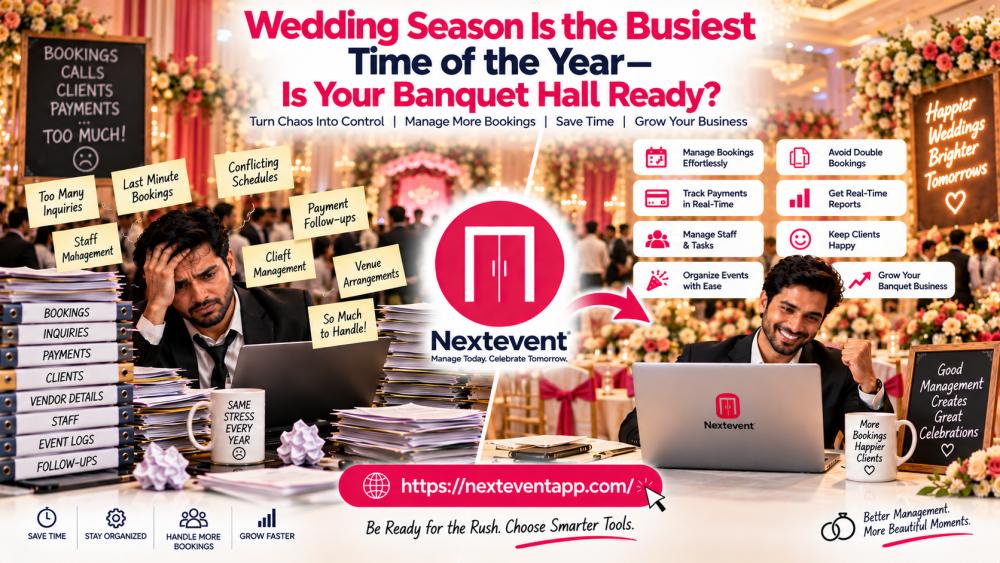
Wedding Season Is the Busiest Time of the Year—Is Your Banquet Hall Ready?

Wedding season can be the most profitable period of the year for a banquet hall, but it can also expose every weakness in the way a venue is managed. When enquiries arrive continuously, customers want instant answers, multiple events overlap, payments become difficult to track, and staff members are working under pressure, even a small mistake can become an expensive problem. The Indian wedding services market continues to expand, with Grand View Research estimating revenue of approximately $133.6 billion in 2026 and projecting a 13.5% CAGR through 2033. That scale creates an enormous opportunity for banquet halls, wedding lawns, resorts, function halls, and convention venues—but only for businesses that are prepared to handle the volume.
Being busy is not the same as being efficient. A hall can have a packed calendar and still lose money because enquiries are forgotten, follow-ups happen too late, payments remain outstanding, staff lack updated information, or two employees unknowingly promise the same date to different customers. Wedding season is therefore not simply a time to accept more bookings; it is a stress test for your entire operation. If your team still depends heavily on paper registers, scattered WhatsApp conversations, spreadsheets, and memory, the question is not whether your banquet hall will become busy. The better question is whether your current system can handle that busy period without creating unnecessary chaos.
Why Wedding Season Can Make or Break a Banquet Hall
During the off-season, manual processes may appear manageable. One person can update a register, another can check a spreadsheet, and the owner can remember which dates are tentative or confirmed. But wedding season changes the equation completely. Instead of receiving a handful of enquiries, a venue may have customers asking about availability, pricing, catering, decoration, rooms, packages, advance payments, and auspicious dates almost simultaneously. The problem is rarely the number of bookings alone; it is the number of decisions and conversations happening around every booking.
The Indian wedding market is also becoming more professional and digitally influenced. IMARC estimates that India's wedding services market reached $32.98 billion in 2025 and could reach $92.67 billion by 2034, with online booking platforms and professional event management among the growth drivers. Customers increasingly expect quick communication and organized service because they can compare venues, packages, and vendors before making a decision. A banquet hall that takes hours to confirm availability may lose a lead to another venue that responds within minutes.
That is why preparation should begin before the first major wedding-season rush arrives. Your goal should be to create a system where every enquiry has a status, every booking has a clear record, every payment has a due date, every staff member knows their responsibility, and every event date can be checked instantly.
The Hidden Cost of Managing Wedding Bookings Manually
Manual management often looks inexpensive because there is no obvious software subscription. Yet the real cost appears through lost opportunities, delayed follow-ups, booking mistakes, payment delays, duplicated work, and employee time. Imagine a customer calls at 11:30 a.m. asking about a Saturday date. Your receptionist writes the enquiry in a notebook but gets interrupted by another customer. Later, the owner receives a WhatsApp message from a different family asking about the same date. Someone checks an old spreadsheet and says the date appears available, while another team member believes it has already been blocked.
Nothing dramatic has happened yet, but the business is already exposed to risk. A single incorrect date can affect catering arrangements, decoration schedules, room reservations, staff allocation, and customer trust. The same problem can happen with payments. If an advance is recorded in one place but the balance is tracked somewhere else, your team may either ask a customer to pay money they have already paid or fail to collect a genuine outstanding amount.
This is why banquet hall management software should be viewed as an operational control system rather than simply another digital tool. The purpose is to create one reliable source of information so your team does not have to reconstruct the status of an event from conversations, notebooks, and spreadsheets.
Build a Centralized Wedding Booking Calendar
A busy wedding season starts with one simple question: Which dates are actually available? Your booking calendar should answer that question immediately. It should clearly distinguish confirmed bookings, tentative enquiries, blocked dates, and available dates. When multiple halls or venues are involved, the calendar should make it possible to understand availability without opening several different files.
A centralized calendar also reduces dependence on individual employees. Suppose your sales executive is absent and a new customer calls. The receptionist should not have to call the owner just to find out whether a particular hall is free. The information should already be available to authorized team members. This becomes especially important during peak wedding periods when customers often want immediate answers.
Modern venue-management platforms can also provide conflict detection. NextEvent, for example, describes a visual booking calendar with conflict alerts and separate visibility for available, tentative, and confirmed dates. The benefit is straightforward: your team spends less time searching for information and more time serving customers.
Capture Every Wedding Enquiry Before It Disappears
A wedding enquiry is not just a phone number. It is a potential booking that may generate venue revenue, catering revenue, decoration revenue, room revenue, and additional service sales. If your team receives enquiries through phone calls, WhatsApp, website forms, walk-ins, social media, or lead platforms, those conversations need to reach one organized system.
The first objective is simple: never allow a genuine enquiry to disappear because someone forgot to record it. Every lead should have essential information such as customer name, contact details, event date, guest count, venue preference, estimated budget, enquiry source, and current status. Once that information exists in one place, your team can decide what action needs to happen next.
NextEvent's current platform information says it can capture enquiries from phone calls, WhatsApp, and walk-ins while tracking lead stages and follow-ups. That kind of centralized lead management becomes particularly useful during wedding season because the volume of enquiries can increase quickly.
Turn Follow-Ups Into a System
One of the biggest mistakes banquet halls make is assuming that an interested customer will call back automatically. Wedding decisions often involve parents, couples, relatives, budgets, venue visits, caterers, decorators, and several competing options. A customer who sounded highly interested on Monday may be speaking with three other venues by Thursday.
A consistent follow-up process keeps your venue visible without requiring staff to remember every conversation. Automated reminders can help teams identify which leads need attention, which customers have not responded, and which enquiries are approaching a decision point. NextEvent currently promotes AI-powered automated follow-ups and WhatsApp communication for venue enquiries.
The goal is not to bombard customers with messages. The goal is to make communication timely, professional, and consistent.
Prevent Double Bookings Before They Become Expensive
Few situations are more damaging to a banquet hall's reputation than a double booking. A customer does not care whether the mistake happened because of an outdated Excel sheet, a missed WhatsApp message, or a communication gap between employees. From their perspective, the venue promised them a date and then failed to deliver.
Peak wedding season increases this risk because several people may be checking availability at the same time. One employee may be negotiating with a customer while another is confirming a different enquiry. If there is no real-time central system, the possibility of conflicting information rises.
A venue booking management system with conflict detection provides an additional layer of protection. NextEvent's current product information specifically highlights real-time conflict alerts and calendar-based visibility for confirmed and tentative bookings.
Your booking workflow should therefore make it difficult for an employee to accidentally reserve an occupied date. The system should clearly communicate what is available, what is temporarily held, and what has already been confirmed.
Track Advances, Pending Payments and Due Dates
A full booking calendar does not necessarily mean healthy cash flow. A banquet hall can have dozens of confirmed weddings while significant amounts of money remain outstanding. Wedding bookings often involve multiple payment stages, so tracking the advance, subsequent instalments, final balance, and payment history is essential.
A manual payment register can become difficult to maintain when the number of bookings rises. Someone may record the advance but forget to update the remaining balance. Another employee may have the payment screenshot in WhatsApp but not update the main record. The owner then has to spend valuable time checking different sources to understand the actual financial position.
Payment management software gives your team a booking-wise financial record. NextEvent describes features for tracking advances, pending balances, payment histories, and automated payment reminders.
This changes the conversation from “I think they have paid” to “The booking record shows exactly what has been received and what remains due.”
Make GST Billing and Quotations Faster
Wedding customers increasingly expect professional documentation. Quotations need to clearly communicate what is included, while invoices and receipts should accurately reflect the services being purchased. When a booking contains venue rental, catering, rooms, decoration, sound, lighting, or other add-ons, manual billing becomes increasingly complicated.
A structured GST billing system can reduce repetitive calculations and make documents easier to generate and share. It also gives your accountant and management team a more organized record of transactions.
NextEvent currently promotes GST invoices and receipts covering venue, rooms, F&B, and additional services, with WhatsApp sharing available. For a busy venue, the practical advantage is speed: your team can spend less time preparing documents manually and more time handling customers and event operations.
Manage Catering, Packages and Add-Ons
The venue rental is only one part of a wedding booking. Catering, decoration, rooms, sound systems, lighting, furniture, entertainment, and other services can contribute significantly to the overall value of an event. Yet these additional services can also create operational confusion when they are tracked separately.
Consider a wedding booking where the sales team promised a specific menu, the customer selected additional rooms, and decoration was added later. If those details exist only in WhatsApp messages, the operations team may not have the complete picture. The result can be incorrect preparation, last-minute changes, or disagreements about what was promised.
A centralized platform can connect the booking with packages, catering, F&B requirements, rooms, and add-ons. NextEvent's current product information includes menu management, packages, multiple services, room bookings, and F&B management.
Connect Sales Promises With Event Operations
The handoff between sales and operations is one of the most important moments in the booking journey. Sales may focus on closing the customer, while operations focuses on delivering the event. If the information passed between them is incomplete, problems appear later.
The booking record should therefore become the shared reference point. Everyone who needs access should see the relevant information based on their role. The accountant can focus on payments and invoices, the chef can focus on menus and catering, the manager can monitor the event, and the sales team can manage customer communication.
Coordinate Staff When Every Date Is Busy
Wedding season puts enormous pressure on people. Front-desk employees handle enquiries, sales teams manage visits, accountants track payments, chefs coordinate menus, decorators prepare setups, and managers oversee events. Without clear responsibilities, the same task may be repeated while another task gets forgotten.
Staff management software can help establish role-based access and responsibilities. NextEvent currently describes role controls for managers, accountants, chefs, decorators, front-desk operators, and other staff.
The objective is not to give everyone access to everything. It is to give the right people access to the information they need to perform their jobs. That creates accountability while reducing unnecessary confusion.
Manage Multiple Halls From One Dashboard
Many banquet businesses eventually operate more than one hall, lawn, party room, or location. Once this happens, managing each venue independently can become difficult. An owner may need to compare bookings, payments, occupancy, and revenue across multiple properties.
A multi-venue management system can bring these operations together while still keeping individual venue information organized. Instead of opening separate spreadsheets for each property, management can use a consolidated dashboard.
NextEvent currently states that it supports multiple halls and locations through a consolidated dashboard and individual venue settings. This becomes particularly useful during wedding season because management can see the bigger picture while staff continue working with the information relevant to their venue.
Use WhatsApp Automation to Stay Connected
For Indian wedding businesses, WhatsApp is already deeply embedded in customer communication. Customers use it to ask questions, receive quotations, confirm details, share payment information, and discuss event requirements. The challenge is that manual WhatsApp communication can become overwhelming when dozens or hundreds of conversations are active.
Automated WhatsApp reminders can reduce repetitive communication. Booking confirmations, payment reminders, event notifications, invoices, and receipts can be delivered through structured workflows instead of requiring employees to compose every message manually.
NextEvent currently lists automated WhatsApp reminders for bookings, payments, enquiries, and important follow-ups.
The key is to use automation where it improves consistency while keeping human communication available for situations that require personal attention.
Use Analytics to Understand Your Wedding Business
During a busy season, instinct can be useful—but data is better. Your management team should know which dates are performing well, how many enquiries are converting, how much revenue has been booked, what payments remain outstanding, and which venues are generating the strongest performance.
A good banquet hall analytics dashboard turns raw booking information into useful business insights. Instead of asking employees for separate reports, management can access a common view of bookings, revenue, payments, occupancy, and trends.
NextEvent's platform includes analytics and reports covering bookings, revenue, payments, occupancy, and business performance.
Once you have reliable data, decisions become easier. You can identify slow periods, evaluate packages, monitor payment collection, and understand which marketing sources are producing valuable enquiries.
Why Cloud-Based Venue Management Matters During Peak Season
Wedding season does not respect office hours. Customers may call after dinner, managers may need to check tomorrow's schedule from home, and owners may be travelling between locations. A system that depends on one office computer becomes a limitation.
Cloud-based venue management software allows authorized users to access relevant information from connected devices. NextEvent states that its platform works across Android, iOS, and desktop environments.
This flexibility matters when the business becomes geographically distributed. An owner can monitor operations while travelling, a manager can check bookings from the venue floor, and staff can update information without waiting for someone to return to a particular computer.
A Practical Wedding-Season Readiness Checklist
Before the season becomes busy, take a hard look at your current processes. Ask your team whether they can answer basic operational questions immediately or whether they need to search through notebooks, spreadsheets, WhatsApp chats, and phone calls.
Your readiness checklist should include:
- Booking calendar: Are all halls and dates visible in one place?
- Enquiries: Is every lead recorded and assigned for follow-up?
- Payments: Can you see advances and pending balances instantly?
- Billing: Can your team generate professional invoices quickly?
- Catering: Are menu selections connected to individual bookings?
- Staff: Does every employee know their responsibility?
- Communication: Are customers receiving timely confirmations and reminders?
- Reports: Can management see revenue and booking performance?
- Multiple venues: Can you manage all locations without maintaining separate systems?
- Backup: Is your business information protected and accessible when required?
The strongest preparation happens before the pressure arrives. You do not want to discover a workflow problem on the busiest Saturday of the season.
How to Choose the Right Banquet Hall Management Software
Not every software platform is designed for the realities of Indian wedding venues. Before selecting a solution, look beyond the number of features listed on a website. Ask whether the system actually fits your workflow.
A useful banquet management software solution should make booking management easier rather than adding another complicated process. It should support your payment structure, customer communication, GST requirements, staff roles, catering needs, and multiple venues if your business operates more than one location.
|
Requirement |
Manual Process |
Smart Management Software |
|
Booking calendar |
Registers/Excel |
Centralized digital calendar |
|
Lead tracking |
WhatsApp/notebook |
Structured enquiry CRM |
|
Follow-ups |
Manual reminders |
Automated workflows |
|
Payment tracking |
Separate records |
Booking-wise payment history |
|
GST billing |
Manual preparation |
Digital invoice generation |
|
Staff coordination |
Calls/messages |
Role-based access |
|
Multi-venue operations |
Separate files |
Consolidated dashboard |
|
Reports |
Manual calculations |
Automated analytics |
|
Customer reminders |
Individual messages |
Automated WhatsApp communication |
The right system should also be easy for your employees to adopt. A powerful platform that nobody uses consistently will not solve your operational problems.
How NextEvent Can Help Prepare Your Banquet Hall
NextEvent positions itself as an AI-powered venue and banquet hall management platform built for Indian venues. Its current feature set covers booking management, enquiry management, payment tracking, GST invoices and quotations, menu management, packages, room bookings, staff roles, WhatsApp reminders, analytics, and multi-venue operations.
The platform is designed for banquet halls, function halls, wedding lawns, convention centers, resorts, auditoriums, and other event venues. Its current Google Play listing also highlights visual booking calendars, conflict alerts, enquiry management, F&B management, room reservations, GST billing, payment tracking, staff permissions, and multi-hall management.
The value of a platform like this becomes most visible during a high-pressure season. Instead of asking, “Where did we record that booking?” your team can work from a shared system. Instead of wondering whether a payment is still pending, the booking record can provide the answer. Instead of manually remembering every follow-up, structured reminders can keep the sales pipeline moving.
That does not mean software replaces your team. It gives your team a stronger operational foundation. Your employees can focus on customers, event quality, sales, and hospitality while repetitive administrative work becomes more organized.
Conclusion
Wedding season is an opportunity—but only if your banquet hall is ready for the workload that comes with it. More enquiries, more bookings, more payments, more staff coordination, and more customer communication can quickly turn into operational chaos when everything depends on paper, spreadsheets, memory, and scattered WhatsApp messages.
The Indian wedding services market is growing, and venues have a significant opportunity to capture that demand. Current market research points to continued expansion, while customers are becoming increasingly comfortable with professional event services and digital booking experiences.
The best time to fix operational weaknesses is before the busiest dates arrive. Build a centralized booking process, capture every enquiry, automate appropriate follow-ups, track payments carefully, simplify billing, coordinate staff, manage catering and add-ons, and use analytics to understand what is happening across your business.
A busy banquet hall should feel organized—not overwhelmed. When the right people have the right information at the right time, wedding season can become more than your busiest period of the year. It can become your strongest opportunity to improve customer experience, protect revenue, and build a more scalable venue business.
FAQs
1. Why is banquet hall management software important during wedding season?
Wedding season creates a sharp increase in enquiries, bookings, payments, customer communication, and operational responsibilities. Banquet hall management software centralizes these activities so teams can manage information more efficiently and reduce mistakes caused by scattered records.
2. Can venue management software help prevent double bookings?
Yes. Modern booking platforms can use centralized calendars and conflict alerts to identify scheduling conflicts. NextEvent, for example, describes real-time conflict detection and visual booking status for confirmed, tentative, and available dates.
3. How can software help banquet halls collect payments?
A digital payment-management system can record advances, payment history, pending balances, and due dates against individual bookings. Automated reminders can also reduce the amount of manual follow-up required from staff.
4. Is banquet management software useful for multiple venues?
Yes. Multi-venue management software can provide a consolidated view of bookings and operations across multiple halls or locations while allowing each venue to maintain its own settings. This is especially useful for growing banquet businesses and venue chains.
5. What should a banquet hall look for before choosing software?
Look for booking management, enquiry CRM, payment tracking, GST billing, customer communication, staff permissions, catering or package management, analytics, multi-venue support, and reliable data access. Most importantly, choose software that your staff can actually use consistently during the busiest days of the season.


