








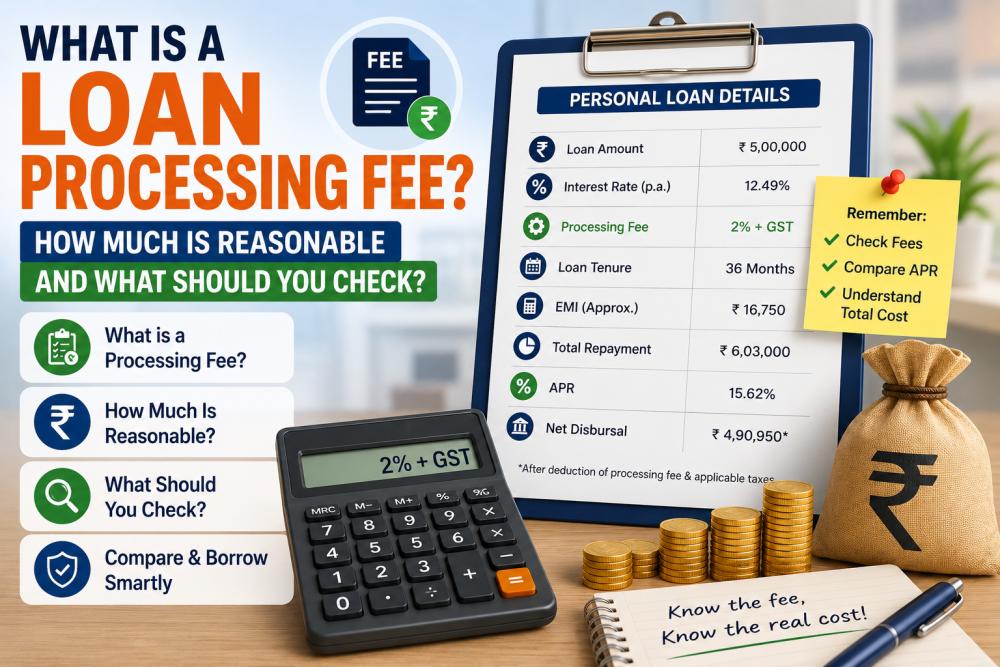
What Is a Loan Processing Fee? How Much Is Reasonable and What Should You Check?

When applying for a personal loan, borrowers often focus on the personal loan interest rate and EMI. However, there are other costs that can affect how much the loan actually costs, including the personal loan processing fee.
A processing fee is a charge associated with processing and evaluating a loan application. Depending on the lender and loan product, it may be charged as a percentage of the sanctioned amount or as a fixed amount.
Understanding personal loan processing fees is important because the fee can reduce the amount you actually receive and increase the overall cost of borrowing.
Before accepting a loan, check the processing fee, applicable taxes, APR, EMI, total repayment, and other disclosed charges.
What Is a Personal Loan Processing Fee?
A personal loan processing fee is a charge imposed by a lender for processing a loan application and completing activities associated with evaluating and setting up the loan.
The exact fee depends on the lender, loan product, borrower profile, and applicable terms.
For example, a lender may specify a processing fee as:
Processing fee = 2% of the sanctioned loan amount
If the sanctioned loan amount is ₹2,00,000:
2% of ₹2,00,000 = ₹4,000
Applicable taxes may also apply depending on the charge.
The actual fee applicable to your loan should be checked in the lender's formal loan documents.
How Much Is a Reasonable Processing Fee?
There is no single reasonable personal loan processing fee that applies to every lender or borrower.
Fees can vary significantly depending on:
-
Loan amount
-
Lender
-
Loan product
-
Borrower profile
-
Loan tenure
-
Promotional offers
-
Type of loan
-
Applicable taxes and charges
Some lenders may charge a percentage of the loan amount, while others may use a fixed fee.
Instead of asking only whether a fee is "high" or "low," compare the complete cost of the loan.
A loan with a slightly higher interest rate but a lower processing fee could potentially have a competitive overall cost compared with a loan offering a lower interest rate but significantly higher fees.
How Is the Processing Fee Calculated?
The calculation depends on how the lender structures the charge.
Percentage-Based Processing Fee
Suppose:
-
Loan amount = ₹3,00,000
-
Processing fee = 1.5%
The processing fee would be:
₹3,00,000 × 1.5% = ₹4,500
Applicable taxes may be added to this amount.
Fixed Processing Fee
Some lenders may instead specify a fixed charge.
For example:
Loan amount: ₹2,00,000
Processing fee: ₹2,500
The applicable fee remains ₹2,500 regardless of whether it is calculated as a percentage.
Always check the actual fee mentioned in your loan offer and Key Facts Statement (KFS) where applicable.
Does the Processing Fee Reduce the Amount You Receive?
It can.
Depending on the loan structure and lender terms, applicable charges may be deducted from the sanctioned amount before the remaining amount is credited to your bank account.
For example:
Sanctioned loan amount: ₹2,00,000
Processing fee: ₹3,000
Applicable taxes: ₹540
Potential net amount:
₹2,00,000 − ₹3,540 = ₹1,96,460
This is only an illustration. Actual deductions depend on the lender and applicable charges.
This creates an important distinction between:
Loan amount sanctioned
and
Net loan amount received
If you need a specific amount in your bank account, check the expected net disbursal before accepting the loan.
Is the Processing Fee Refundable?
Whether a personal loan processing fee is refundable depends on the lender's terms and the circumstances of the application or loan.
Don't assume that the fee will automatically be refunded if you change your mind.
Before paying or accepting a loan, check:
-
Whether the fee is refundable
-
When the fee becomes payable
-
Whether it is deducted from disbursal
-
Applicable cancellation conditions
-
Applicable taxes
-
Other related charges
The lender's formal documentation should take priority over promotional statements.
Processing Fee vs Interest Rate
The processing fee and interest rate are different costs.
The interest rate determines the interest charged on the outstanding loan according to the loan's repayment structure.
The processing fee is a separate charge associated with processing the loan.
For example:
Loan A
-
Interest rate: 12%
-
Processing fee: 2%
Loan B
-
Interest rate: 12.5%
-
Processing fee: 0.5%
You cannot determine which loan is cheaper simply by comparing the interest rates.
Instead, calculate:
Interest + applicable fees + taxes + other applicable costs
This gives you a better understanding of the overall borrowing cost.
What Is the Difference Between Processing Fee and APR?
This is an important distinction when comparing personal loan costs.
The processing fee is one specific charge.
APR (Annual Percentage Rate) is a broader annualised measure of the cost of credit that incorporates applicable charges under the relevant regulatory framework.
Therefore:
Processing fee = individual loan charge
APR = broader annualised cost measure
When comparing loan offers, look at the disclosed APR along with the processing fee, EMI, tenure and total repayment.
Why Should You Check the Key Facts Statement?
For applicable loans, the Key Facts Statement (KFS) is an important document to review before accepting the loan.
The KFS helps borrowers understand key loan terms and costs in a standardised format.
Before accepting a personal loan, check the KFS for information such as:
-
Loan amount
-
Interest rate
-
APR
-
Repayment schedule
-
Processing fee
-
Other applicable charges
-
Important loan terms
Don't rely only on the number shown in an advertisement or loan app.
Compare the KFS with the final loan agreement and ask the lender for clarification if something is unclear.
How Processing Fees Affect Personal Loan Comparison
Consider two hypothetical loan offers:
| Loan Detail | Offer A | Offer B |
|---|---|---|
| Loan amount | ₹3 lakh | ₹3 lakh |
| Interest rate | 12% | 12.5% |
| Processing fee | 2% | 0.5% |
| Tenure | 36 months | 36 months |
| APR | Check KFS | Check KFS |
| Total repayment | Calculate | Calculate |
Offer A has the lower interest rate, but its processing fee is higher.
Offer B has a higher interest rate but a substantially lower processing fee.
The better option depends on the complete cost, including applicable charges.
This is why personal loan comparison should never be based on the interest rate alone.
What Other Personal Loan Charges Should You Check?
Before accepting a loan, review all applicable charges.
These may include:
-
Processing fee
-
Applicable taxes
-
Late-payment charges
-
Bounce charges
-
Prepayment charges, where applicable
-
Foreclosure charges, where applicable
-
Other disclosed fees
Not every charge applies to every loan.
Your formal loan documents should clearly state the applicable costs and conditions.
How to Avoid Paying More Than Necessary
Compare Multiple Loan Offers
Don't automatically accept the first offer you receive.
Compare interest rate, APR, processing fee, EMI and total repayment.
Calculate the Net Amount
Check how much money you will actually receive after applicable deductions.
Look Beyond the EMI
A lower EMI can result from a longer tenure, potentially increasing total interest.
Read the KFS
Review the Key Facts Statement before accepting an applicable loan offer.
Check All Charges
Don't focus exclusively on the processing fee. Look at the complete borrowing cost.
Borrow Only What You Need
A larger loan means more interest and potentially higher fees.
Example: Comparing Two Processing Fees
Suppose you need ₹5 lakh.
One lender charges a 2% processing fee:
₹5,00,000 × 2% = ₹10,000
Another lender charges 0.75%:
₹5,00,000 × 0.75% = ₹3,750
The difference is:
₹6,250
Applicable taxes and other charges can affect the final amount.
However, the lender with the lower processing fee isn't automatically the cheapest. You must also compare its interest rate, APR, tenure and total repayment.
Common Mistakes to Avoid
Looking Only at the Processing Fee
A low fee doesn't guarantee a low-cost loan.
Ignoring Applicable Taxes
Check whether taxes apply to the disclosed fee.
Confusing Sanctioned Amount With Net Disbursal
You may receive less than the sanctioned amount after applicable deductions.
Focusing Only on Interest Rate
The lowest interest rate may not result in the lowest overall cost.
Not Reading the Loan Documents
Always review the KFS and final loan agreement before accepting the loan.
Paying an Unverified Advance Fee
Be cautious if an unknown party asks you to transfer money upfront to "unlock" or "guarantee" a loan. Verify the actual lender and payment instructions through official channels.
Personal Loan Processing Fee Checklist
Before accepting a loan, check:
☑ Processing fee
☑ Applicable taxes
☑ Interest rate
☑ APR
☑ EMI
☑ Loan tenure
☑ Net amount received
☑ Total repayment
☑ Prepayment conditions
☑ Late-payment charges
☑ Key Facts Statement
☑ Actual lender details
Final Thoughts
A personal loan processing fee may appear small compared with the loan amount, but it can affect both the amount you receive and the overall cost of borrowing.
There is no universal "reasonable" processing fee because charges vary between lenders and loan products. The better approach is to compare the processing fee, interest rate, APR, EMI, tenure, net disbursal and total repayment together.
Before accepting a personal loan, carefully review the Key Facts Statement, loan agreement and all applicable charges.
Most importantly, don't choose a loan simply because it advertises a low interest rate or low processing fee.
The right personal loan is one whose complete cost is clear, whose repayment fits your budget, and whose terms you understand before accepting it.


