








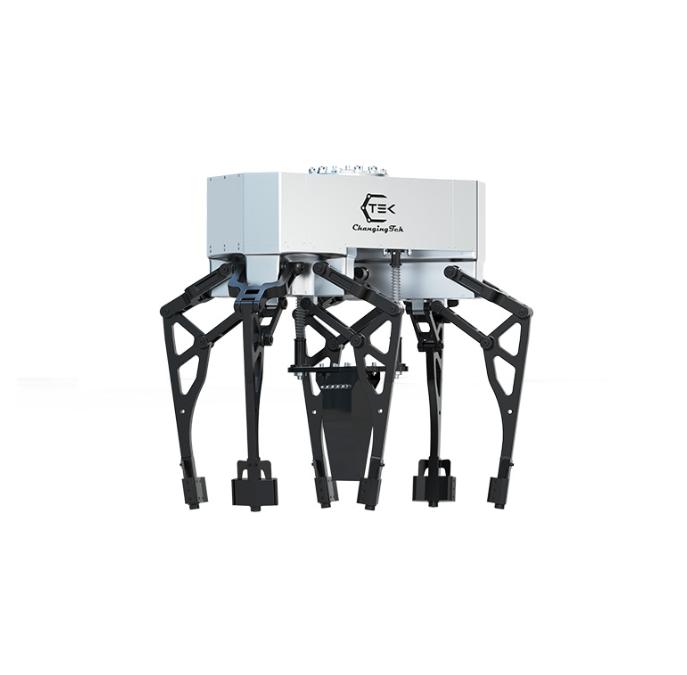
How will cobot gripper solutions develop in the future?

As semiconductor manufacturing processes continue to advance towards 3nm and 2nm nodes, the requirements for wafer handling have also increased. Electric grippers, as the key actuators connecting the equipment to the wafer, are undergoing a transformation from "mechanical hands" to "intelligent terminals". In the next five years, cobot gripper solutions will accelerate their evolution along three paths: intelligence, integration, and miniaturization.
1. Intelligent upgrade of force control technology
The current force control technology can already achieve precision control at the 0.1N level, but the future direction is for the grippers to "perceive" and "think" on their own. Fingers with integrated high-density pressure sensing arrays can real-time monitor the force distribution on the wafer surface and automatically adjust the grasping strategy. Machine learning-based force control algorithms can automatically optimize parameters based on different wafer types, thickness, and surface conditions, with operators only needing to select the wafer specifications, significantly reducing the debugging threshold. Predictive force control functions can intervene milliseconds before a defect occurs, eliminating risks at the embryonic stage.
2. Deep integration of vision and sensing
The next generation of cobot gripper solutions will deeply integrate vision and sensing functions. Micro cameras are embedded inside the fingers, and during the grasping process, they can monitor the position and posture of the wafer in real time, automatically compensating for alignment deviations. Laser ranging sensors can precisely measure the thickness and warpage of the wafer, providing real-time feedback for force control. Multi-sensor data fusion technology integrates visual, force, and tactile information to form a comprehensive perception of the handling process, significantly enhancing handling safety.
3. Modularization and rapid changeover
The flexible trend in semiconductor production lines requires equipment to have the ability to quickly changeover. Future electric grippers will adopt highly modular designs, with fingers, drivers, and controllers all capable of being quickly replaced. The one-click changeover function allows the gripper to switch between different wafer specifications automatically load the corresponding parameters, reducing the switching time from hours to minutes. Standardized interface design enables different manufacturers' grippers to be interchangeable, reducing the risk of equipment investment lock-in.
4. Digital twin and virtual debugging
Digital twin technology will change the debugging and operation mode of electric grippers. In the virtual environment, a high-precision model of the gripper is established, allowing 90% of the parameters to be debugged before the new product is launched, significantly reducing the actual debugging time. During operation, the digital twin model synchronizes the physical device status in real time, supporting remote diagnosis and virtual training. Through historical data accumulation and simulation, the remaining life of the equipment can be predicted, optimizing maintenance plans.
5. Green energy saving and sustainable development
Energy consumption control and environmental protection requirements are influencing the design concept of electric grippers. New efficient motors and energy feedback systems can reduce energy consumption by 30%. The non-lubrication design reduces the maintenance burden in the clean room while also reducing the consumption of lubrication materials. Product design begins to consider the carbon footprint throughout the life cycle, from material selection to报废回收, all meeting sustainable development requirements. These changes are both driven by regulations and reflect industry responsibility.
cobot gripper solutions https://www.changingtek-robotics.com/collaborative-gripper-series


