








How Much Does a Residential Fire Alarm System Cost?

Early detection saves lives and limits damage—so most homeowners ask a practical question: how much does a Fire Alarm System for a residence actually cost? The answer isn’t a single number. It depends on the system type, coverage, integration needs, and operational requirements such as monitored reporting and battery backup for fire alarm system continuity. Below I explain the factors that determine cost, the difference between basic house fire alarm system options and more advanced residential installations, and what buyers in India should evaluate to get the best long-term value.
What a Fire Alarm System is
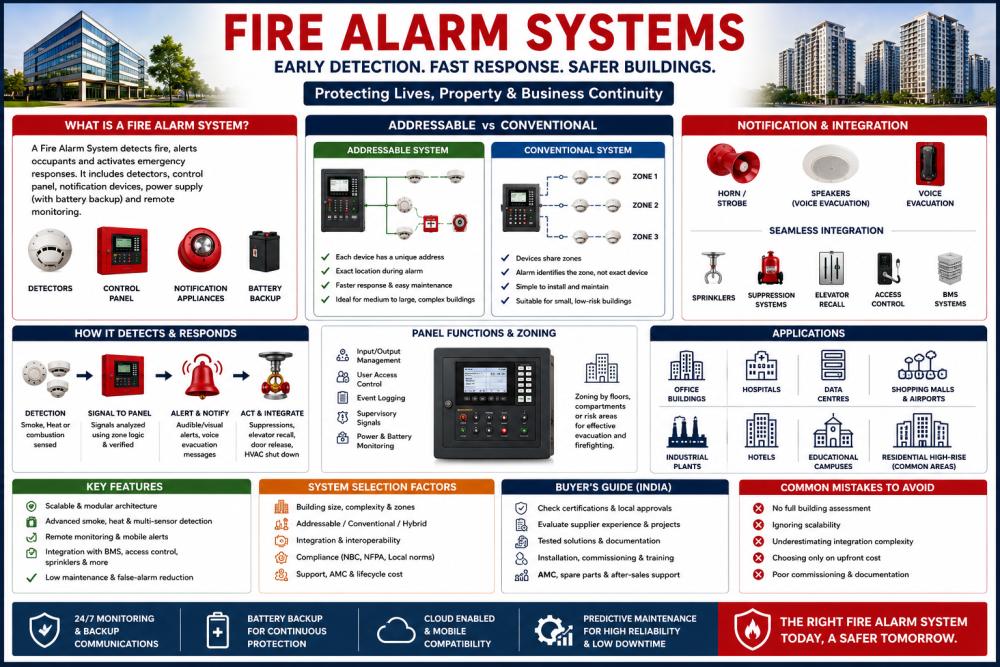
A Fire Alarm System combines detectors (smoke, heat, CO, multi-sensor), notification devices (horns, strobes, voice), a control panel, power supplies with batteries, and optional communication links to central stations. For homes, configurations range from simple battery-powered smoke detectors to fully wired, addressable panels integrated with security systems. Even a basic home fire alarm system must meet code and provide supervised power and reliable detection.
Why costs vary
Costs reflect scope and engineering, not just hardware price. Key cost drivers:
- Number and type of detection points (smoke vs aspirating vs multi-sensor)
- Architecture: conventional, addressable, or wireless fire alarm system
- Panel capabilities (local annunciation, event logging, voice evac)
- Remote monitoring options—fire alarm system remote monitoring via IP or GSM
- Power design and battery sizing (battery fire alarm systems and backup)
- Integration with sprinklers, access control, or home automation
- Installation complexity, commissioning, and testing
- After-sales support, AMC, and warranty
Basic residential options
Standalone battery detectors: Low upfront cost, simple DIY installation, no central monitoring. Suitable for small apartments where code allows a house fire alarm system.
Interconnected wired detectors: Provide whole-home alarm annunciation when one device triggers. Require wiring and professional installation for reliability.
Wireless fire alarm system kits: Offer easier installation for retrofits. Devices communicate with a local control panel or hub; battery replacement and RF reliability must be considered.
Addressable residential panels: Provide device-level diagnostics and are appropriate for large homes or residential high-rise apartments where precise location and supervised circuits matter.
Commercial-grade features in homes
Some homeowners opt for higher-spec equipment—aspirating detectors for server rooms, multi-sensor detectors to reduce false alarms, or panels with remote notification. Incorporating fire alarm system equipment and features typical of commercial fire alarm systems increases cost but improves detection accuracy, maintenance diagnostics, and integration potential.
Remote monitoring and lifecycle costs
Adding fire alarm system remote monitoring changes both cost and operational profile. IP or cellular paths transmit verified alarms to a central monitoring station, triggering emergency dispatch or notified contacts. There are subscription fees (monthly or annual), and initial costs for communication modules. Factor recurring monitoring charges and AMC costs into lifecycle calculations.
Battery and power considerations
Battery fire alarm systems and appropriate battery backup for fire alarm system operation are non-negotiable. Batteries must be sized for required runtimes and maintained under supervision. The cost includes quality batteries, chargers, and regular replacement—often overlooked when buyers focus only on device price.
Key features to consider (value over price)
- Scalable system architecture to add devices later
- Smoke, heat, and multi-sensor detection for varied risks
- Reliable local notification and voice-evac options where needed
- Remote monitoring capability and mobile alerts
- Integration capability with security, sprinklers, and home automation
- Clear panel interface and fault diagnostics
- Predictive maintenance readiness and low false-alarm performance
- Long operational life and modular component replacement
- Certified installation and reliable 24/7 monitoring if subscribed
Applications and when to upgrade
- Small flats and single-family homes: interlinked smoke detectors or simple wired systems may be sufficient.
- Multi-level homes, home offices, or properties with critical equipment (server room/UPS): consider addressable panels and aspirating or multi-sensor detectors.
- Residential high-rise apartments: common-area panels with supervised circuits are required; integration between apartment-level detectors and building panels is critical.
- Smart homes: wireless fire alarm system devices can integrate with automation, but ensure life-safety independence from consumer Wi-Fi.
System selection factors (engineering focus)
When comparing quotes, don’t only compare device prices. Evaluate:
- Detector coverage calculations, device counts, and placement strategy
- Panel capacity, supervised circuits, and expansion slots
- Battery sizing and certified backup runtimes
- Inclusion of supervised communication modules for remote monitoring
- Installation, commissioning, and testing scope
- Training, documentation, and AMC terms
- Code compliance and local authority approval procedures
Buyer’s checklist for India
Choose a fire alarm system supplier with a proven portfolio, compliance knowledge (NBC and local codes), and strong commissioning discipline. Confirm that the supplier and installers perform device-level testing, battery validation, and provide clear handover documentation. Verify available options for Fire alarm system installation so the final design matches both safety objectives and operational preferences.
Common mistakes to avoid
- Picking cheapest detectors without coverage planning
- Skipping professional design and commissioning
- Undersizing batteries or ignoring supervised power
- Opting for IP-only monitoring without backup cellular paths
- Overlooking AMC and periodic testing obligations
Final guidance
A basic, code-compliant house fire alarm system can be economical, but true protection depends on proper placement, supervised power, and appropriate detection technology. For homeowners who value resilience, adding supervised battery fire alarm systems, remote monitoring, and robust panel equipment is a prudent long-term investment. Prioritize engineering quality, verified installation, and a supplier that supports testing and maintenance to ensure reliable protection and operational peace of mind.


